Does Cooking Fermented Food Kill The Bacteria?
Yes, above about 46 degrees. But heat does not undo everything fermenting did, and there are good reasons to cook it anyway. Here is what survives, what does not, and how to keep the live part when you want it.
Yes. Heat kills the live bacteria in fermented food, and it does not take much heat to do it.
Lactic acid bacteria start dying above about 46°C. By 60°C the population is falling fast. By 70°C, held for a few minutes, there is effectively nothing left alive. Every one of those temperatures is well below simmering, let alone boiling.
But heat does not undo what fermenting did. Most of the benefit stays, and there are good reasons to cook fermented food anyway. This covers what survives, what does not, and how to keep the live part when that is what you are after.
The temperature ladder
Useful to have the actual numbers, because "cooking" covers a very wide range.
Up to 40°C. Nothing much happens. This is inside the range where these bacteria are comfortable — it is roughly yoghurt incubation temperature. Warming fermented food to blood heat does not harm it.
40 to 46°C. The upper edge of survival. Some strains manage, some struggle. Food at this temperature feels properly warm but not hot.
46 to 60°C. Dying off, increasingly quickly as the temperature rises.
60 to 70°C. Rapid kill. Held for a few minutes, this is effectively pasteurisation.
Above 70°C. Nothing survives. Anything simmering, frying, baking or boiling is far past this.
For comparison: a hot cup of tea is around 70 to 80°C. A simmer is around 90°C. Boiling is 100°C. Frying is 160°C and up. There is no ordinary cooking method that leaves live bacteria in food.
What survives cooking
Rather more than people expect, which is why cooked fermented food is still worth eating.
The acid. Lactic acid is a stable molecule and heat does nothing to it. Cooked sauerkraut is exactly as sour as raw sauerkraut.
The flavour. Everything the bacteria built — the sourness, the savouriness, the depth — survives. It changes character with cooking, as all flavours do, but it is not destroyed.
The broken-down phytic acid. This is the important one. Fermenting breaks down the compound in grains and pulses that blocks mineral absorption. Once broken down, it stays broken down. Sourdough bread is baked at 220°C and still delivers the mineral benefit, because the work was done before the oven.
The freed minerals. Iron, zinc, calcium and magnesium made available by fermenting stay available.
Most B vitamins. The ones the microbes manufactured largely survive moderate cooking. Some loss occurs, particularly with long boiling and if you throw the cooking water away.
Vitamin K2. Heat stable. Cooked natto and aged cheese keep it.
The freed isoflavones in soya, and the other compounds fermenting converted into more available forms. Tempeh is always cooked, and none of its advantages over plain soya depend on live organisms.
Fibre. Unaffected.
What is lost
The live bacteria. All of them, in any real cooking.
Vitamin C. This one is a genuine loss. Sauerkraut is a notable source of vitamin C, and vitamin C is heat-sensitive. Boiling destroys a large proportion of it and leaches more into the water. If vitamin C is why you eat sauerkraut, eat it raw.
Bacterial enzymes. Proteins, denatured by heat. The lactase in yoghurt that helps lactose-intolerant people is one of these — cooked yoghurt loses it.
Some volatile flavour compounds. The fresh, sharp top notes go and the flavour becomes rounder and deeper. Not worse, but different.
One exception: spores
Most fermenting bacteria die at the temperatures above. One kind does not.
Bacillus subtilis, which makes natto, forms spores — a dormant, armoured state that survives boiling. Spore-forming bacteria are the reason some foods need pressure canning rather than a water bath.
Practically this means natto retains some viable organisms through cooking where other ferments do not. It is a curiosity rather than a reason to change what you do, and the nattokinase enzyme natto is valued for is heat-sensitive regardless, so cooking natto still costs you the main thing.
Why cook it anyway
Plenty of good reasons, and they are worth stating because the live-bacteria question can make people forget that these are foods.
Because it tastes better that way. Sauerkraut cooked slowly with pork and juniper is one of the great dishes of Europe. Kimchi stew is a staple in Korea. Miso in soup is the entire point of miso for most people. None of these were invented as health foods and all of them are better hot.
Because it is more digestible. Cooking softens fibre and makes cabbage considerably easier on the gut. For anyone who finds raw fermented vegetables uncomfortable, cooked is a real option.
Because the texture is wrong for the dish. Frozen or old kraut that has lost its crunch is much better cooked than served raw.
Because it was always going to be cooked. Sourdough, tempeh, idli, injera. Nobody eats these raw and their benefits do not depend on it.
Because you are not sure about it. A jar you are slightly doubtful about is safer cooked. This is a weak reason — if you doubt a ferment, throw it out — but heat does deal with a marginal one.
How to keep it alive
When the live culture is what you want, the technique is simple: add it at the end.
Off the heat. Cook the dish, take the pan off the hob, wait a minute, then stir in the ferment. The residual heat will warm it without killing it if you are quick, though a very hot pan will still do damage.
As a topping. Sauerkraut on a hot dish, kimchi on rice, yoghurt spooned onto a curry. The ferment stays cool while the food underneath is hot, and only the contact surface is affected.
Alongside rather than in. A forkful on the side of the plate. This is how these foods are traditionally eaten anyway.
Miso specifically. Take the stock off the heat and let it drop below about 60°C before whisking the miso in. Boiling miso soup is a common instruction to avoid in Japanese cooking, and the reason given is usually flavour rather than culture — boiling drives off the aroma. Both reasons point the same way.
Yoghurt in a sauce. Stir it in at the end, off the heat. This also stops it splitting, which it will do if boiled.
Shop-bought is usually already dead
Worth knowing before you worry about your cooking method.
Most fermented food sold at ambient temperature has been pasteurised for shelf life. That includes almost all tinned and jarred sauerkraut, most supermarket pickles, most shelf-stable kimchi and a good deal of miso.
Pasteurisation is exactly the process described above, done in a factory. If you bought a jar off an ambient shelf, there is nothing live in it and how you cook it makes no difference to that.
Live products are almost always sold chilled, and say so — look for "unpasteurised", "live", or "raw" on the label, in the refrigerated section.
This is also the answer to a common confusion. People who taste no difference between their homemade kraut and a jar from the shelf are often comparing a live food with a cooked one without realising it.
Do the dead bacteria still do anything?
A fair question, and the answer is genuinely uncertain rather than yes or no.
There is a research area around what are variously called postbiotics or paraprobiotics — the idea that dead bacterial cells and the compounds they produced still interact usefully with the gut and the immune system.
The reasoning is plausible. Bacterial cell walls carry structures the immune system recognises, and those structures do not stop existing when the cell dies. The metabolites the bacteria produced during fermentation — organic acids, peptides, vitamins — are all still there.
Some studies show effects from heat-killed bacterial preparations. The field is real and active.
What cannot yet be said is that eating cooked sauerkraut gives you the benefits of eating raw sauerkraut. That is an extrapolation from early research, and anyone stating it as fact is going beyond the evidence.
The sensible position: cooked fermented food is good food that keeps most of its nutrition. Whether the dead organisms do anything useful is an open question. Do not cook it and then claim the probiotic benefit.
Warming without killing
There is a narrow window between cold and dead, and it is usable if you want warm fermented food that is still alive.
Anything up to about 40°C is safe for the culture. That is properly warm to the touch — warmer than blood heat, cooler than a hot drink. It is the temperature yoghurt is incubated at, so by definition the bacteria are comfortable there.
Practically, that means you can take sauerkraut out of a cold fridge and let it come to room temperature, or warm it gently in a bowl over warm water, without harming it. What you cannot do is put it in a pan.
The test without a thermometer: if you can hold your finger in it comfortably for several seconds, it is under 45°C or so. If it makes you pull away, it is too hot.
This matters most in winter, when nobody wants a spoonful of fridge-cold cabbage next to a hot dinner. Taking it out twenty minutes before the meal solves it entirely, and is easier than any clever warming method.
Reheating leftovers
A question that follows on, and the answer is simple: once it has been cooked, the culture is already gone and reheating changes nothing.
The ordinary food safety rules apply as they would to any leftover — cool it quickly, refrigerate it, reheat it thoroughly once. The acidity of fermented food makes it a comparatively safe leftover, but it is not a licence to leave a pot on the stove overnight.
Raw fermented food is different again. A jar of sauerkraut in the fridge is not a leftover in the ordinary sense. It is a preserved food at pH 3.4 and it keeps for months. Take out what you need with a clean fork, keep the rest under the brine, and put it back.
The one habit worth breaking is eating directly from the jar or using a used fork in it. That introduces food debris and saliva into a jar you intend to keep for months, and it is the commonest reason a good jar of kraut goes off early.
Dish by dish
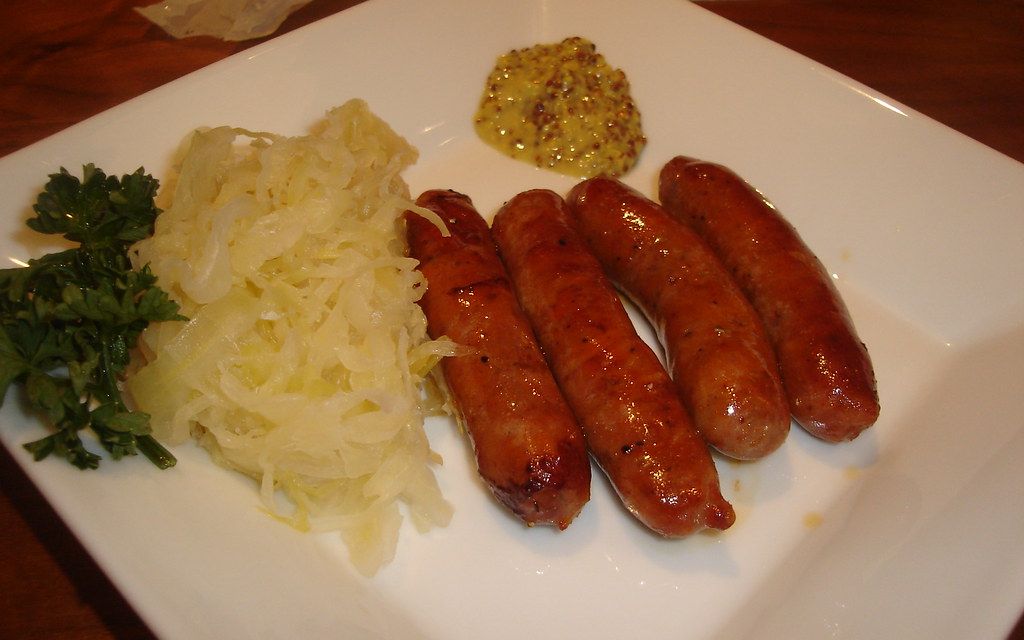
Sauerkraut with sausage. Cooked, and rightly so. If you want live culture at the same meal, put a spoonful of raw kraut on the side as well.
Kimchi stew. Cooked. Kimchi is at its best in this dish and the fermentation flavour is the whole basis of it.
Kimchi fried rice. Cooked, and better for old, very sour kimchi than fresh.
Miso soup. Stir the miso in off the heat, below 60°C.
Yoghurt sauces and marinades. Off the heat, or accept the loss.
Sourdough. Baked, always. Nothing is lost that mattered.
Tempeh. Cooked, always. It should not be eaten raw.
Kefir. Do not heat it. It is a drink, and heating splits it and ruins it.
Cheese. Cooking kills whatever cultures were live in it. Nobody minds, and it is not why most people eat cheese.
Cooking against freezing
Both reduce the live culture, and they are not equivalent.
Cooking kills essentially all of it, immediately, and also costs you vitamin C and the bacterial enzymes.
Freezing kills most of it but not all — a proportion of the lactobacilli survive, and thawed kraut retains some live culture. Freezing keeps vitamin C well.
Freezing costs you texture. Cooking changes texture as well but usually in a way the dish wanted.
Cold storage costs you nothing at all, which is the reason to use it wherever possible.
Mistakes worth avoiding
Boiling miso. Kills the culture and drives off the flavour in one go.
Adding yoghurt to a simmering sauce. It splits and it dies.
Cooking a ferment and then counting it as a probiotic serving. It is good food; it is not that.
Assuming a shop jar was ever alive. Most were not.
Avoiding cooking these foods entirely. Some of the best dishes in the world are cooked ferments. Eat both.
The short version
Heat above about 46°C kills the live bacteria, and everything above 70°C kills all of them. No ordinary cooking leaves any alive.
What survives is the acid, the flavour, most of the vitamins, the freed minerals and everything fermenting changed structurally. What is lost is the live culture, the vitamin C and the bacterial enzymes.
So cook it when the dish wants it cooked, and keep some raw on the side of the plate when you want the live part. Both are worth having, and they are not in competition.