Does A Reverse Osmosis System Remove Fluoride?
Yes — typically 85 to 95 per cent. A complete guide to how the membrane does it, what changes the figure, what else reverse osmosis removes, the waste water question, the alternatives for fluoride, and what does not work at all.

Yes. A working reverse osmosis system removes most of the fluoride from your water — typically 85 to 95 per cent, and often more.
It is the most effective method available to a household, and it is one of only three that work at all. This guide covers how the membrane does it, what makes the figure better or worse, what else comes out along the way, what it costs in wasted water, and the several popular methods that remove no fluoride whatsoever.
How reverse osmosis works
Osmosis is a natural process. Put pure water on one side of a semipermeable membrane and salty water on the other, and water moves towards the salty side on its own, trying to even things out. It is how plant roots draw water from soil.
Reverse osmosis does exactly what the name says: it runs that process backwards, using pressure.
Mains water pressure pushes against the membrane. Water molecules are forced through to the clean side. Almost everything dissolved in the water is too large or too electrically charged to follow, and is left behind. That rejected material is flushed away down the drain, carrying the contaminants with it.
The membrane itself is a thin film with pores of around 0.0001 microns. For comparison, a good carbon block filters at about 0.5 microns — five thousand times coarser. A bacterium is roughly a micron. A virus is a tenth of that. Even they are enormous compared with the openings in an RO membrane.
The membrane is not a sieve in any ordinary sense. It is a barrier that water can diffuse through and most dissolved substances cannot.
Why fluoride specifically gets removed
Fluoride in water exists as the fluoride ion — a single fluorine atom carrying a negative charge.
It is a very small ion, which is why almost nothing else catches it. Carbon does not adsorb it. Sediment filters pass it straight through. It is far too small for any conventional filtration.
Reverse osmosis works on a different principle, and that is why it succeeds. The membrane rejects dissolved ions on the basis of size and charge, and it is especially good at rejecting ions carrying more charge or existing as larger hydrated clusters.
Fluoride, though small on its own, surrounds itself with a shell of water molecules in solution — it is strongly hydrated. That effective size, combined with its charge, is what the membrane rejects. Manufacturers typically quote 90 to 95 per cent rejection for fluoride, and independent testing broadly supports it.
What changes the number
The 85 to 95 per cent figure is a range for a reason. Several things move it.
Water pressure
The single biggest factor. Pressure is what drives water through the membrane, and more pressure means better rejection as well as more water.
Most domestic membranes want at least 2.8 bar (about 40 psi) and perform best at 4 to 5.5 bar. Below about 2.8 bar, output falls away and rejection drops with it.
If your pressure is low, a booster pump fixes it, and it improves both the amount of water you get and how clean it is. On a low-pressure supply this is the upgrade that makes the largest difference.
Water temperature
Cold water is more viscous and passes through more slowly. Membranes are rated at 25°C, and most household cold supplies are well below that — often 10 to 15°C.
The effect is on output more than on rejection: a system might produce half its rated volume on a cold winter mains. Rejection stays reasonably good, but the tank fills far more slowly than the box promised.
Membrane age and condition
Rejection falls as a membrane ages, fouls with scale, or suffers damage. A new membrane might reject 97 per cent of dissolved solids. Near the end of its life it may be down to 80.
Nothing about this is visible. The water tastes the same and flows the same. The only way to know is to measure, which is covered below.
How much is in the water to start with
Rejection is a percentage, not a fixed removal. A supply at 1.0 mg/l of fluoride with 95 per cent rejection leaves 0.05 mg/l. A supply at 4.0 mg/l with the same membrane leaves 0.2 mg/l.
Both are large reductions. On a naturally high-fluoride borehole, though, you may want a second stage rather than relying on percentage alone.
Membrane type
Two kinds are common. Thin film composite is the standard now: higher rejection, better output, and destroyed by chlorine. Cellulose triacetate tolerates chlorine but rejects considerably less.
Almost every domestic system uses thin film composite, and that is why a carbon pre-filter is not optional. Chlorine reaching the membrane will ruin it, sometimes within days. If you take one maintenance lesson from this guide, it is that the carbon pre-filter protects the expensive part.
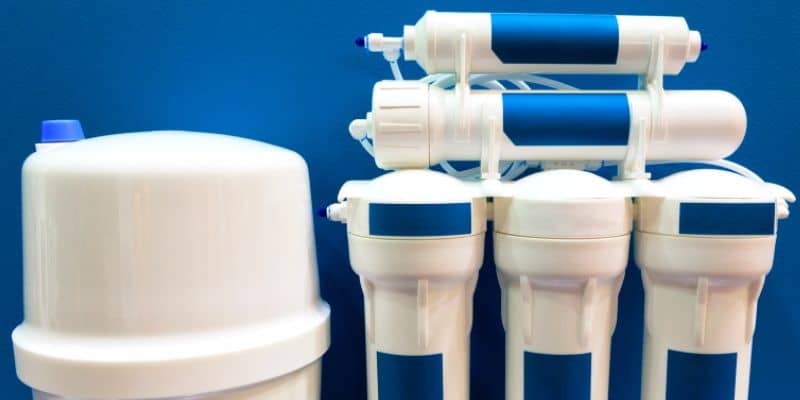
What a complete system looks like
The membrane is one component among several, and the others exist mostly to protect it.
Stage one — sediment pre-filter. Usually five microns. Catches grit and rust that would physically damage or block the membrane.
Stage two — carbon pre-filter. Removes chlorine before it reaches the membrane. On a chloraminated supply this should be catalytic carbon, which handles chloramine far better than standard carbon.
Stage three — the membrane. The actual reverse osmosis. Produces clean water slowly, and sends the rejected water to drain.
The storage tank. Because production is slow — a few litres an hour — the system fills a small pressurised tank so that you get a usable flow when you open the tap.
Stage four — carbon post-filter. A final polish on the way out, removing any taste picked up from sitting in the tank.
Optional — remineralisation. A cartridge adding calcium and magnesium back. Covered below.
Optional — ultraviolet. Rarely needed on mains water, sensible on a private supply.
What else comes out
Fluoride is one item on a long list. This is the broadest-spectrum treatment available to a household, and the approximate rejection figures for a healthy membrane run roughly as follows.
Above 95 per cent: lead, arsenic, nitrates, sulphates, most heavy metals, dissolved salts generally, and PFAS — the so-called forever chemicals, which very little else touches.
90 to 97 per cent: fluoride, chromium, copper, calcium and magnesium hardness, sodium, radium.
Effectively complete: bacteria, viruses, protozoa and cysts. They are vastly larger than the membrane pores. Note that a membrane is not a certified disinfection barrier, because a pinhole would not announce itself — on genuinely unsafe water, use UV as well and do not rely on the membrane alone.
Also removed: pesticide and herbicide residues, pharmaceutical residues, microplastics, and the great majority of dissolved organic compounds.
This breadth is the real argument for reverse osmosis. You do not have to identify every contaminant and buy a specific medium for each. It deals with most of them at once.
What reverse osmosis does not remove
Dissolved gases. Carbon dioxide, radon, hydrogen sulphide. Gases pass through the membrane. This is why RO water is often slightly acidic — dissolved CO2 comes through and forms carbonic acid.
Some small uncharged organic molecules. A few small volatile compounds pass. The carbon stages catch most of them, which is another reason the carbon is there.
Chloramine, at the membrane. The membrane does not remove it and is damaged by it. The pre-filter has to.
Anything the system is not treating. RO is point-of-use. The water in your shower, your bath and your washing machine is untouched.
The waste water question
This is the genuine downside, and it deserves plain treatment.
Reverse osmosis works by rejecting contaminants into a stream of water that goes down the drain. That stream is not optional — it is what carries the contaminants away and what keeps the membrane from clogging.
Older systems commonly ran at three or four litres to drain for every litre produced. Some cheap ones are worse.
Modern systems do considerably better. Tankless units with internal pumps commonly achieve one or two to one. Some claim better than that.
A permeate pump is an inexpensive non-electric device that fits to a conventional tank system and typically cuts waste by half to three-quarters. On any tank-based system it is the best value improvement available, and it speeds up tank filling as well.
Two things worth keeping in perspective. First, the volume is smaller than it sounds — a household drinking and cooking with ten litres a day of RO water wastes perhaps twenty to forty litres, which is less than a single bath. Second, the waste water is not contaminated in any dramatic sense. It is simply more concentrated than what went in, and some people plumb it to a water butt for the garden. Do check your local plumbing rules before doing that, and do not use it on anything if your supply is high in sodium or boron.
Is RO water too pure?
A common objection, and the answer is more boring than either side suggests.
Reverse osmosis removes calcium and magnesium along with everything else, and the resulting water contains very few minerals. It is also slightly acidic, usually somewhere around pH 6 to 6.5, because dissolved carbon dioxide passes through.
The concern is that this deprives you of dietary minerals. In practice, drinking water is a minor mineral source for most people compared with food. Removing it does not create a deficiency in anyone eating an ordinary diet.
That said, there are two reasonable arguments for adding minerals back. Mineral-free water tastes flat, and many people simply prefer the taste with some calcium and magnesium in it. And slightly acidic water is marginally more aggressive to metal plumbing downstream, which matters for the short run of pipe and the tap after the system.
A remineralisation cartridge costs little, adds a small amount of calcium and magnesium, and lifts the pH back towards neutral. It is worth having for the taste alone. It is not a health necessity.
Why people want fluoride removed
Worth setting out neutrally, because it is the reason most people arrive at this question.
Fluoride is added to some public water supplies at around 0.7 to 1 mg/l to reduce tooth decay. Major public health bodies, including the World Health Organization, support this, and the evidence that it reduces cavities at population level is long-standing.
Fluoride also occurs naturally, sometimes at much higher levels. In parts of India, China, and East Africa, natural concentrations run several times higher than any deliberate addition, and skeletal fluorosis from long-term high exposure is a documented and serious problem in those areas.
The reasons people give for removing it from their own supply vary. Some are concerned about total exposure once toothpaste, tea and processed food are counted. Some object to medication being added to a public supply as a matter of consent. Some have naturally high fluoride water and a genuine reason. Some simply prefer to choose what is in their water.
Those are different arguments of different strengths and this guide is not going to adjudicate them. If you want it out, reverse osmosis is how it comes out, and the rest of this explains how to do that properly.
The alternatives for fluoride
Only three methods remove fluoride from household water. Reverse osmosis is one.
Activated alumina
Aluminium oxide media that adsorbs fluoride specifically. Removal of 90 per cent or better is achievable, so on paper it matches RO.
In its favour: no waste water, no pressure requirement, leaves other minerals alone, and works in gravity systems.
Against it: it needs long contact time to hit those figures, so flow must be slow. It works best in slightly acidic water and performs poorly above about pH 8.5. The media has a finite capacity and gives no warning when exhausted. And it removes fluoride and very little else.
Bone char
Charred animal bone, largely calcium phosphate, which binds fluoride. The traditional method and still used, particularly in gravity filters.
In its favour: natural material, no waste water, works by gravity.
Against it: less consistent than the other two, with removal varying widely by product and by contact time. Not vegetarian or vegan. Quality varies considerably between suppliers.
Distillation
Boil the water, condense the steam. Fluoride is not volatile, so it stays behind.
In its favour: extremely thorough — arguably the most complete removal of anything of the three.
Against it: slow, and it uses a great deal of electricity. A distiller producing four litres takes several hours and consumes real energy doing it. It also removes everything, so the water is very flat.
Which to choose
For most households, reverse osmosis, because it deals with fluoride and everything else at the same time for one installation and one set of running costs.
Choose activated alumina if you specifically want fluoride removed and nothing else changed, or if you have no pressure and need a gravity system. Choose distillation only if you have a particular reason for wanting water that pure and do not mind the electricity.
What does not remove fluoride at all
This list matters, because every item on it is widely believed to work.
Carbon filters. Under-sink carbon blocks, tap-mounted filters, fridge filters. Excellent for chlorine and taste. No effect on fluoride.
Filter jugs. Brita and similar are carbon and ion exchange resin aimed at hardness and taste. They do not remove fluoride, and the ones that claim to are using a small amount of a different medium with modest results.
Standard whole house filters. Sediment and carbon at point of entry. No fluoride removal, and the flow rate makes it impractical there anyway.
Sediment filters. Not remotely — fluoride is dissolved, not suspended.
Ordinary ceramic filters. They filter by pore size and fluoride is far too small.
Water softeners. They exchange calcium and magnesium for sodium. Fluoride is untouched.
Boiling. This one is worth stating clearly because it does the opposite of what people expect. Boiling evaporates water and leaves fluoride behind, so the concentration in what remains goes up. Boiling water to reduce fluoride makes it worse.
Freezing. No.
Letting it stand. Chlorine will off-gas if you leave water out. Fluoride will not.
Tank, tankless or countertop?
Three formats, and the choice affects waste, speed and how much cupboard you lose.
Conventional tank systems
The traditional arrangement. The membrane produces water slowly into a pressurised storage tank, and the tap draws from the tank.
For: no electricity needed, cheapest to buy, simple, standard cartridges, decades of proven design.
Against: the tank is bulky, water sits stored and can taste flat, waste ratios are poor without a permeate pump, and the tank bladder is a maintenance item.
Tankless systems
An internal electric pump pushes water through a larger membrane fast enough to supply the tap directly, with no storage.
For: far more compact, much better waste ratios, always fresh water rather than stored, usually a digital TDS display built in.
Against: needs a power socket under the sink, more expensive, cartridges are frequently proprietary, and it stops entirely in a power cut.
Countertop systems
A self-contained unit that sits on the worktop. Some connect to the tap, some are filled by jug.
For: no plumbing at all, no hole in the worktop, comes with you when you move. The right answer for renters.
Against: takes up worktop space, smaller capacity, and the jug-fed ones need refilling and emptying by hand.
Which
Own your home and have cupboard space — a tank system with a permeate pump is the best value. Short of space or bothered about waste water — tankless. Renting, or unwilling to drill the worktop — countertop.
Reverse osmosis against a gravity filter
Worth comparing directly, because these are the two systems most people choose between.
A gravity filter — a countertop unit with ceramic or carbon composite elements — needs no plumbing, no pressure and no power. Water goes in the top and works its way down. It is excellent for taste, chlorine, sediment, many organic chemicals and, with the right elements, bacteria and protozoa. Some offer separate fluoride elements as an add-on.
Reverse osmosis needs plumbing, pressure and a drain. It removes considerably more, particularly dissolved minerals, nitrates, salts and PFAS, and it removes fluoride as standard rather than as an accessory.
Choose the gravity filter if you want no plumbing, no power dependency, portability, or a system that works in an outage and on stored water. It is the better emergency and off-grid option by a distance.
Choose reverse osmosis if you want the most thorough removal available, particularly of dissolved contaminants, and you have mains pressure and a place to plumb it.
Plenty of households have both, and that is not as odd as it sounds. The RO handles daily drinking water; the gravity unit sits in a cupboard for power cuts and for filtering rainwater or stored water when it is needed.
Protecting the membrane on difficult water
Membranes are the expensive part and they are killed by three things. Knowing which applies to you decides what goes in front.
Chlorine and chloramine destroy thin film composite membranes chemically. The carbon pre-filter is the whole defence. On a chloraminated supply, use catalytic carbon and change it on time.
Hardness scales them. Calcium and magnesium concentrate in the reject stream, and on very hard water they precipitate onto the membrane surface as scale. That reduces output and rejection permanently. If your water is very hard, softening ahead of the RO extends membrane life considerably — and a softener is a good partner for an RO because the sodium the softener adds is then removed by the membrane.
Sediment and iron foul them. Fine particles and oxidised iron blind the surface. On a borehole, proper pre-filtration is not optional, and iron should be dealt with before the water reaches the membrane at all.
On a private supply generally, reverse osmosis is best thought of as the last stage of a treatment train rather than as a stand-alone product. Test first, treat the bulk problems, and let the membrane do the fine work.
Other things RO water is good for
Once you have a system, several uses turn out to be worth the extra tap.
Coffee and tea. A genuine improvement, though not straightforwardly. Water with no minerals at all actually extracts coffee poorly — some mineral content helps the flavour compounds dissolve. Pure RO water tends to taste thin and sour. This is one of the better arguments for a remineralisation stage, and specialist coffee mineral blends exist for exactly this.
Ice. Cloudy ice is dissolved minerals and trapped air. RO water gives noticeably clearer cubes.
Aquariums. Marine and soft-water tanks frequently require RO water as a starting point, remineralised to a specified profile. For reef keeping it is close to essential, because nitrates and phosphates in mains water feed algae.
Steam irons and humidifiers. No minerals means no scale and no white dust. This alone extends the life of a steam generator iron substantially.
Seed starting and sensitive plants. Carnivorous plants and some orchids genuinely need low-mineral water and suffer in hard tap water. Ordinary vegetables do not care.
Car and window washing. No dissolved solids means no spots when it dries. This is exactly what professional window cleaners use, and it is why they can leave glass without drying it.
Why whole house reverse osmosis is usually wrong
It exists, and for a small number of properties it is the right answer. For most it is not, and it is worth understanding why before somebody sells you one.
The problem is throughput. A domestic under-sink membrane produces a few litres an hour. A house needs 30 or 40 litres a minute at peak. Bridging that gap means large commercial membranes, a big pressurised storage tank, a pump to repressurise the house from that tank, and considerable space.
The waste water scales up with it. Treating every drop the house uses — showers, laundry, toilets, the garden — means rejecting a proportion of all of it to drain. That is a great deal of water to throw away in order to flush a lavatory with it.
The cost follows, in equipment, installation, membrane replacement and running.
Then there is the water itself. Fully demineralised water throughout the house is mildly aggressive to copper pipework and needs remineralising afterwards to be sensible, which is another stage.
The cases where it does make sense are genuine but narrow: a supply so high in dissolved solids that nothing else will make it usable, brackish or coastal boreholes, or specific commercial requirements. For a normal house wanting clean drinking water, an under-sink unit does the same job for a fraction of the cost and waste.
Fluoride you get from everything else
If the point of the exercise is reducing total exposure, water is one input among several, and it is worth knowing where the rest comes from.
Toothpaste is the largest single source for most people by concentration — typically 1,000 to 1,500 parts per million, which is over a thousand times the level in fluoridated water. Almost all of it is spat out, but young children swallow a meaningful proportion, which is why the advice for small children is a smear rather than a strip.
Tea is the surprise. The tea plant accumulates fluoride from soil, and black tea brewed strong can contribute more fluoride than a day's drinking water. Older leaves, used in cheaper teas and in some brick teas, carry more.
Food and drink made with fluoridated water carries it through — anything processed, brewed or reconstituted in a fluoridated area.
Some foods naturally, particularly fish eaten with the bones, and some grape products.
None of this argues for or against filtering your water. It is simply the context: removing fluoride from the tap reduces one input and does not eliminate exposure, and anyone counting seriously should count the tea.
Testing, and knowing your system still works
Two different measurements, and people confuse them.
A TDS meter
A cheap handheld device measuring total dissolved solids — everything dissolved, added together. It does not measure fluoride and cannot tell you your fluoride level.
What it does do is tell you whether the membrane is still working, and that is genuinely valuable. Measure the water going in and the water coming out. Divide and you have your rejection percentage.
A healthy system should reject 90 per cent or better. If your mains reads 300 ppm and your RO water reads 15, that is 95 per cent and the membrane is fine. If the RO water has climbed to 60, rejection has fallen to 80 per cent and the membrane needs replacing.
Take a reading when the system is new and write it down. That baseline is what every later reading is compared against, and without it the numbers mean much less. Check every few months. It takes seconds and it is the only warning you will get.
An actual fluoride test
If you want the fluoride number itself, that needs a specific test — either a laboratory sample or a fluoride test kit.
On mains water you probably do not need one. Your supplier publishes the level for your area, free, and it is legally required to be accurate. On a private supply you should test, because natural fluoride varies enormously with geology and nobody else is looking.
Installing one
A standard under-sink system is within reach of a competent DIYer, and takes two or three hours the first time.
What is involved: a tee into the cold supply under the sink, the filter housings mounted on the cupboard wall, the storage tank standing in the cupboard, a small dedicated tap drilled into the worktop or sink, and a connection to the waste pipe for the drain line.
The drain connection is the part people find awkward. Traditionally a saddle clamp on the waste pipe; better systems use a proper waste adapter. It must be above the trap and arranged so waste cannot siphon back. In the UK this falls under the water fittings regulations and needs appropriate backflow protection — worth checking before you start rather than after.
Drilling the worktop for the tap is the irreversible step. Granite and quartz need a diamond core and a steady hand, and many people have that one job done professionally even when they fit the rest themselves.
Space. A tank system needs real cupboard room — the tank alone is roughly the size of a football, and you need clearance under the housings to change cartridges. Tankless systems are more compact but need a power socket.
First run. Fill and discard the first two or three tanks. New membranes and cartridges carry manufacturing residue and preservative, and the first water through tastes of it.
Keeping it working
Sediment and carbon pre-filters: every six to twelve months. This is the job that protects everything else. A neglected carbon pre-filter lets chlorine reach a thin film composite membrane, and that is how a membrane rated for five years dies in six months.
Carbon post-filter: every twelve months.
Membrane: every two to five years, depending on your water and how well you have looked after the pre-filters. Let the TDS reading tell you rather than the calendar.
Sanitise annually when you change cartridges. A weak sanitising solution through the housings and the tank, thoroughly flushed. Damp filter housings are a place bacteria will grow given long enough.
Check the tank pressure annually. The tank has an air bladder, pressurised to around 0.5 bar when empty. It loses pressure over years, and a flat tank is the commonest cause of a system that suddenly gives you a dribble. A bicycle pump and a tyre gauge fix it in five minutes, with the tank drained first.
What it costs
The system. A basic four or five stage under-sink unit is modest. Tankless systems with pumps cost more. Systems with remineralisation and UV cost more again.
Installation. Free if you do it, a few hundred pounds if a plumber does, plus the worktop hole if the material is difficult.
Running. Pre-filters and post-filters annually, a membrane every few years. The annual cost is modest and predictable. Compare it against bottled water for a household and it pays back quickly.
Water. The waste stream, which is small in household terms and smaller still with a permeate pump.
Electricity. None on a conventional tank system. A small amount on a tankless or booster-pumped one.
When something goes wrong
Slow flow or a small amount of water. Check the tank pressure first — it is usually that. Then blocked pre-filters, then low mains pressure, then cold water, then a failing membrane.
Water tastes bad. Usually an exhausted post-filter. Also possible: water that has sat in the tank for a week, or a system that has not been sanitised in years.
The drain runs constantly. A failed automatic shut-off valve, or a check valve stuck open. It wastes a lot of water quietly, so if you can hear trickling when nobody is drawing water, deal with it.
TDS reading creeping up. The membrane is losing rejection. Confirm the pre-filters are not overdue, then replace the membrane.
Cloudy or fizzy water at first. Dissolved air, and it is harmless. It clears in a glass within a minute.
Claims worth ignoring
"RO water is acidic and makes your body acidic." It is mildly acidic, at around pH 6 to 6.5 — roughly the same as milk, and far less acidic than any fruit juice, coffee or fizzy drink. Your stomach runs at about pH 2. Nothing you drink changes your blood pH, which is regulated within a very narrow range regardless of diet.
"RO water leaches minerals out of your body." This appears constantly and has no basis. Drinking low-mineral water does not strip minerals from your tissues. Water is a modest dietary source of minerals in the first place, and food supplies the rest.
"It removes 99.9 per cent of everything." It removes a great deal, and the figure varies by contaminant, by membrane condition and by pressure. Dissolved gases pass through entirely. Treat single headline percentages as marketing.
"It wastes more water than you save." An exaggeration in a domestic setting. A household using ten litres of RO water a day rejects perhaps twenty to forty litres, which is less than one bath and a fraction of what a washing machine uses. The waste is real and worth reducing; it is not the scandal it is sometimes made out to be.
"Alkaline ionised water is better." A different product solving a different imagined problem, and the health claims behind it are not supported. If you want mineral content back in RO water for taste, a remineralisation cartridge does that for very little.
"You never need to change the membrane." Membranes lose rejection gradually and give no outward sign. This is exactly why the TDS baseline matters.
Before you buy
- Find out your fluoride level — from your supplier's report or a test.
- Check your water pressure. Below 2.8 bar, plan for a booster pump.
- Measure the cupboard. Tank systems need more room than people expect.
- Look at the waste ratio, and budget for a permeate pump on a tank system.
- Check the cartridges are a standard size, not proprietary.
- Look for NSF/ANSI 58 certification, which is the standard covering RO systems.
- Decide about remineralisation — worth it for taste.
- Buy a TDS meter at the same time and record the baseline on day one.
The short version
Reverse osmosis removes 85 to 95 per cent of fluoride, and usually more when the system is new and the pressure is good. It is the most practical method for a household and it removes almost everything else at the same time.
Keep the pressure up, change the carbon pre-filter on time so it protects the membrane, and check the TDS reading every few months against the baseline you took when it was new.
And be clear about what does not work. Carbon filters, filter jugs, softeners, standard whole house systems and boiling all leave fluoride exactly where it was. Boiling makes it worse.