How Much Coop Space Does A Chicken Need?
Four square feet inside and ten in the run, per standard hen — and why the perch length and the pop-hole matter more than most people realise. Plus what overcrowding actually looks like.
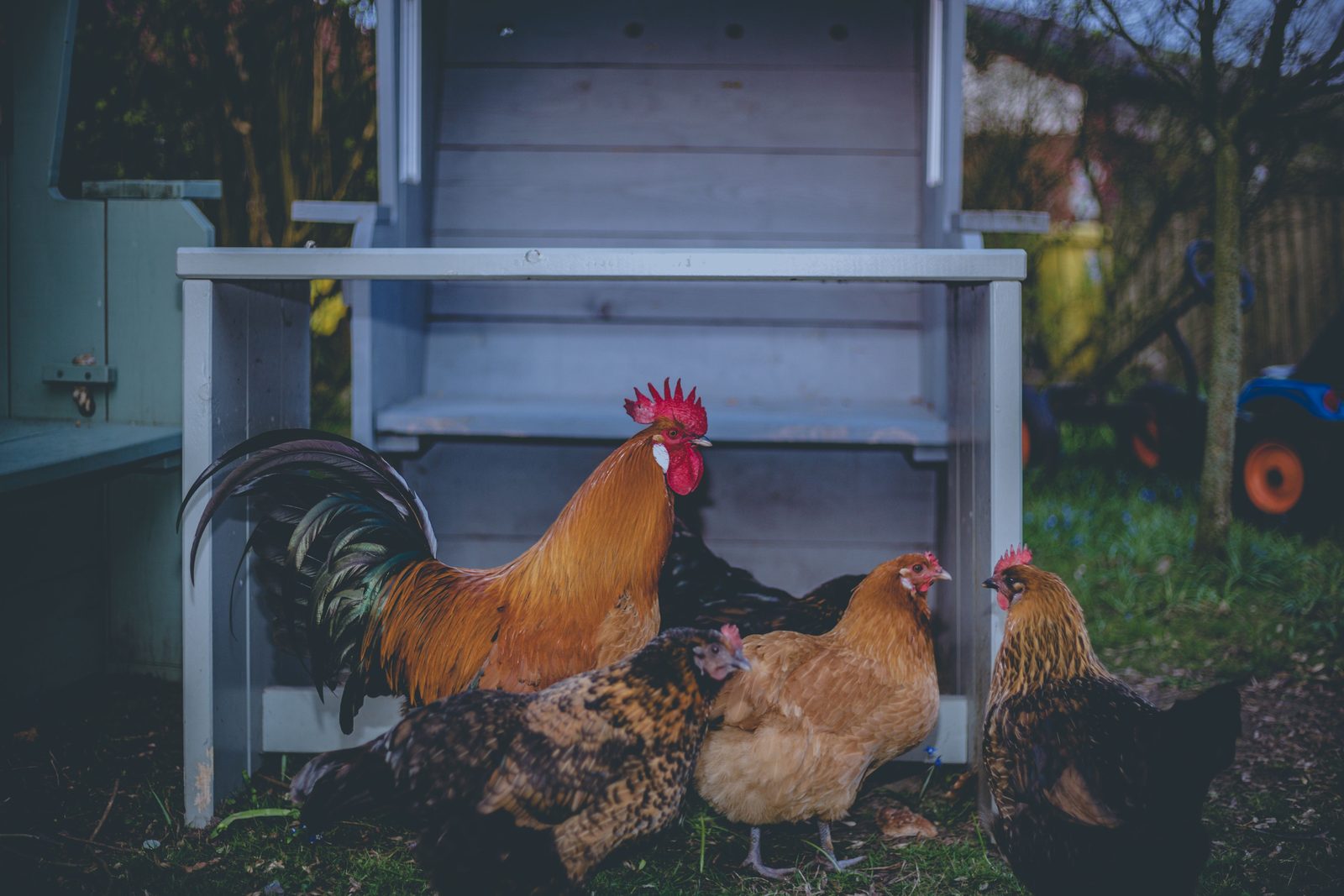
The short answer, for a standard laying hen: four square feet inside the coop and ten square feet in the run, each. In metric, roughly 0.37 square metres inside and 0.93 outside.
But floor area on its own is the least useful of the numbers, and it is the only one most coop makers quote. Perch length, nest boxes, ventilation and the width of the pop-hole all cause more trouble than square footage does, and a coop sold as suitable for eight birds is very often suitable for four.
The numbers
| Bird | Coop floor | Run | Perch |
|---|---|---|---|
| Standard hen (Sussex, Orpington, Rhode Island Red) | 4 sq ft / 0.37 m² | 10 sq ft / 0.93 m² | 10 in / 25 cm |
| Light breed (Leghorn, hybrid layer) | 3 sq ft / 0.28 m² | 8 sq ft / 0.74 m² | 8 in / 20 cm |
| Bantam | 2 sq ft / 0.19 m² | 5 sq ft / 0.46 m² | 6 in / 15 cm |
| Large fowl (Brahma, Jersey Giant) | 5–6 sq ft / 0.46–0.56 m² | 15 sq ft / 1.4 m² | 12 in / 30 cm |
Those are minimums for birds that also get out. A flock permanently confined needs considerably more, and the run figure should be treated as a floor rather than a target.
Why floor area is the least of it
A coop can hit the square footage and still be too small, because chickens do not use floor space evenly. Four things run out before the floor does.
Perch length
Every bird roosts at night, and they all want to be on the perch. Ten inches each for a standard hen, and 30 centimetres of clear space between parallel perches so they are not sitting on each other.
This is where most bought coops fail. A coop advertised for eight birds with a single 60-centimetre perch has room for two or three. The rest end up on the floor or in the nest boxes, and birds sleeping in nest boxes foul the eggs.
Perches should also be higher than the nest boxes. Chickens want to roost at the highest available point, and if the nest boxes are higher they will sleep in those instead.
Nest boxes
One box per three or four hens. More than that is wasted — they will queue for their favourite regardless, and a bank of eight boxes for eight birds means six unused and two contested.
A box about 30 centimetres cubed suits a standard hen. Fitted lower than the perches, in the darkest corner you can manage.
Ventilation
The most underrated number, and it is not really a number so much as a design rule.
Chickens produce a lot of moisture, from breathing and from droppings. Damp air condensing in a cold coop is what causes frostbite and respiratory disease — not the cold itself. A dry coop at minus five is fine. A damp one at plus two is not.
You need continuous ventilation high up, above the birds' heads, so warm damp air leaves without a draught blowing across the roost. Roughly one square foot of vent per ten square feet of floor, all of it high. Meshed with 12 millimetre welded mesh, and never closed in winter.
The instinct to seal a coop up for winter is the single most common cause of harm to a flock.
The pop-hole
The door the birds use. Wide enough for two birds to pass, or a bird at the bottom of the pecking order will be trapped inside or outside by one guarding it. Around 30 centimetres wide and 35 tall for standard hens.
A single narrow pop-hole is a genuine bullying point in a flock, and it is invisible until you watch for it.
Where the four square feet comes from
It is worth knowing that this figure is a keeper's rule of thumb rather than a law, because it stops people treating it as either sacred or arbitrary.
Commercial free-range standards work to far higher densities than four square feet — birds indoors at nine per square metre, which is closer to one square foot each. Those systems get away with it through mechanical ventilation, controlled lighting, all-in all-out flocks and a bird that lives about eighteen months.
A backyard flock has none of that. No fan, natural light, mixed ages, birds kept for years, and a keeper who is not there for most of the day. Four square feet is the density at which a coop stays dry, the pecking order stays stable and the litter stays manageable without any of the commercial machinery.
So it is not a welfare minimum in the legal sense. It is the point at which a small flock looks after itself, which is what you actually want.
The winter question
Space matters most in the weeks when the birds use it least willingly.
In bad weather a flock stays in. Short days, driving rain and snow on the ground mean birds that normally spend ten hours outside spend most of the day in the coop. A space that is comfortable in June with the pop-hole open from five in the morning can be genuinely crowded in January.
Three things follow from that.
Size for the worst week, not the average. If the coop only works when the birds are out, it does not work.
Give them a covered outdoor space. A roofed section of run, or even a sheet of board over one corner, means birds go out in the rain instead of standing about inside. This does more for winter crowding than making the coop bigger.
Do not reduce the ventilation. The instinct in cold weather is to close things up, and the birds are producing more moisture in a space they are occupying for longer. That is exactly when high, permanent ventilation earns its keep.
Adding birds to a flock you already have
The space calculation changes when the flock does, and this is where people get caught out.
Work out the new total first. Four square feet each applies to the flock you will have, not the one you have now. Three extra hens in a coop that was exactly right for six is a coop that is now half the size it should be.
Expect it to be worse than the arithmetic for a while. New birds are introduced into an established pecking order, and that order is re-established through pushing, chasing and pecking. In a tight coop there is nowhere for the newcomers to get away, and what would be a week of squabbling becomes real injury.
More feeders and drinkers, in more places. One of each is a bottleneck that the established birds will hold. Two, at opposite ends, removes the choke point.
Quarantine first anyway, for two to three weeks, for disease reasons — and it has the useful side effect that the birds see each other through mesh before they share a coop.
What too little space actually does
Not just discomfort. Crowding drives specific, recognisable problems.
Feather pecking, then cannibalism. The first and most reliable sign. Birds with nowhere to go start on each other, and once there is blood it escalates fast.
Bullying at the bottleneck. One bird holds the feeder, the drinker or the pop-hole. The lowest-ranked birds lose condition and stop laying, and it looks like illness.
Damp litter and ammonia. More birds on the same floor means more droppings and more moisture. Ammonia you can smell at head height is well past the level that damages a bird's airway.
Disease spreading faster. Everything from mites to respiratory infection moves more easily through a crowded flock.
Eggs laid on the floor, because the nest boxes are contested or the boxes are being slept in.
Birds refusing to go in. A flock that hangs about at the pop-hole at dusk rather than going up is often telling you the coop is unpleasant.
Signs you have enough
Easier to judge by behaviour than by tape measure.
All the birds are on the perch at night with space between them. Nobody is on the floor and nobody is in a nest box.
Feathers are intact, particularly around the vent and the back.
Birds go in willingly at dusk without being chased.
The litter is dry and crumbly and the coop does not smell of ammonia when you put your head in at bird height in the morning — that is the real test, not standing in the doorway.
Birds spread out during the day rather than clustering.
The run
Ten square feet each is a minimum, and it is the number most worth exceeding. Birds are outside for most of their waking hours.
What is in the run matters as much as its size. A bare rectangle of mud is dull and gets muddier; the same area with a dust bath, something to perch on, a pile of leaves to scratch through and some cover to get under supports far more birds happily.
Vertical space counts. A perch, a log, a pallet on bricks — anything that lets birds get up and away adds usable room without adding footprint.
Cover matters. Chickens are prey animals and open ground makes them uneasy. A few shrubs or a board on legs and they use the whole run instead of huddling by the coop.
Ground recovers or it does not. At the minimum stocking density grass will not survive. Either accept bare earth and manage it with wood chip, or move the run, or give more space.
Free ranging
Birds with genuine free range need less run, but the coop figure does not change — they still all sleep in it, and that is where perch length and ventilation apply.
Do not use free ranging to justify a small coop. Weather, illness and predator scares all mean birds shut in for a day or more, and a coop that is only adequate when they can get out is inadequate when they cannot.
Measuring a coop honestly
Five minutes with a tape settles what a manufacturer's description never will.
Measure the usable floor, not the footprint. Take out the area under nest boxes that sit on the floor, under a broody coop, or behind a fixed feeder. If a bird cannot stand on it, it does not count.
Measure the perch as a single total. Add up every length of roosting bar. Then check the parallel ones are 30 centimetres apart — two perches 15 centimetres apart are one perch, because the birds cannot use both.
Do the two sums and take the smaller answer. Floor divided by four; perch divided by ten inches. A 4 by 4 foot coop is 16 square feet, so four standard hens on floor area. If it has 90 centimetres of perch, that is three birds. Three is the answer.
Then check the height. Perches need 45 centimetres of clear space above them so a bird can stand and stretch, and enough below that droppings do not land on the floor the birds walk on.
Then use your nose. Put your head in at bird height first thing in the morning, before the pop-hole has been open. If it catches at the back of your throat, the ventilation or the stocking density is wrong, whatever the tape said.
Buying a coop
Ignore the number on the box. Manufacturers' bird counts are optimistic almost without exception, and a fair rule is to halve them.
Measure the internal floor and divide by four. Measure the total perch and divide by ten inches. Take the lower of the two answers — that is what it holds.
Then check the ventilation is high and permanent, the nest boxes are lower than the perches, and the pop-hole is wide enough for two.
And build or buy bigger than you need now. Flocks grow. Everybody's flock grows.
The short version
Four square feet of coop floor and ten of run per standard hen, with ten inches of perch each and one nest box per three or four birds.
Check the perch length before the floor area — it runs out first, and it is why a coop sold for eight birds usually holds four.
Ventilate high and permanently, and never shut it up for winter. Damp does the damage, not cold.
Then judge it by the birds: everyone on the perch at night, feathers intact, willing to go in at dusk, and no smell of ammonia at bird height in the morning.