How To Clean Activated Carbon Water Filters To Make Them Last Longer
You can rinse the outside of a carbon block and buy back some flow. You cannot restore the carbon itself. Here is the difference between the two failures, what cleaning achieves, and what to never do.
You can clean the outside of a carbon filter and get some flow back. You cannot clean the carbon itself, and nothing you can do at home will restore it.
Those are two different failures with two different answers, and telling them apart is the whole subject.
The two ways a carbon filter fails
Failure one: it is blocked
Sediment, rust, silt and scale build up on the outside surface of the cartridge and form a cake. Water cannot get through easily, and the flow drops.
This is a physical blockage on the surface. It is mechanical, it is visible, and it can be removed.
The symptom: the flow slows down. The water still tastes fine.
Failure two: it is exhausted
The carbon has used up its capacity. Every available surface inside the pores has something stuck to it, and nothing more can attach.
This is chemical, it happens inside the granules where you cannot reach, and nothing you can do at a kitchen sink will undo it.
The symptom: the flow is normal. The water tastes of chlorine again, or of nothing in particular while quietly not being filtered.
Why this distinction matters
Cleaning fixes the first and does nothing for the second. A cartridge that has slowed down may well be worth rinsing. A cartridge that has stopped removing chlorine is finished, however clean it looks.
The trap is that exhaustion gives no visible sign. An exhausted cartridge looks identical to a new one, flows identically, and produces clear water. If you are relying on it for anything without a taste — and most contaminants have no taste — you will never know.
How adsorption works, and why it is one-way
Worth understanding, because it explains why every home remedy fails.
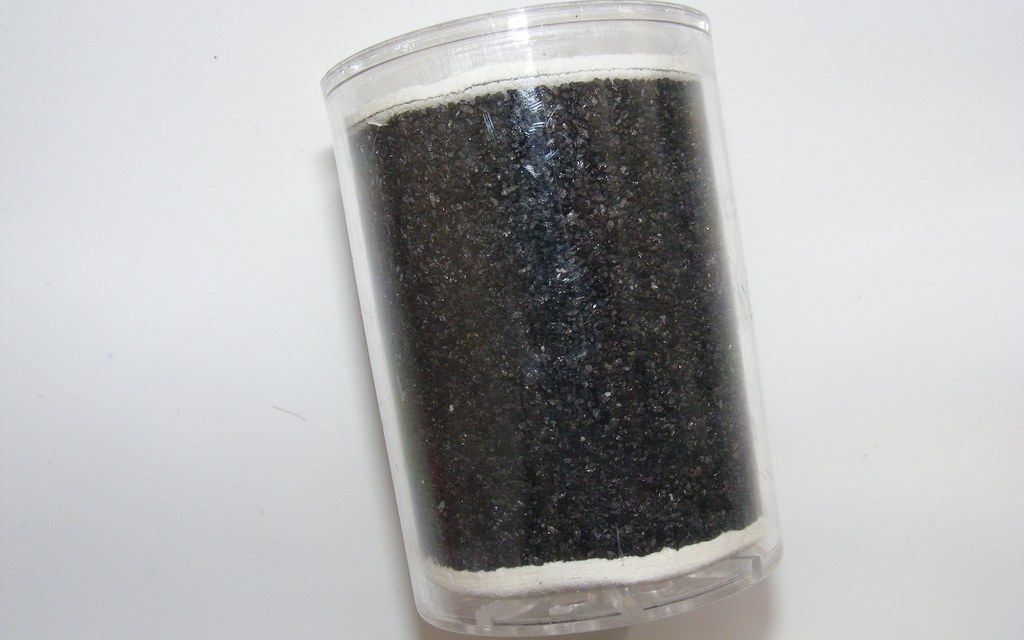
Activated carbon is riddled with microscopic pores. The internal surface area is enormous — several hundred square metres in a single gram. Contaminants passing through are held on those internal surfaces by molecular attraction. The word is adsorption: sticking to a surface, not soaking in.
The attraction is weak individually and there is a great deal of it. Under ordinary conditions — room temperature, water, no pressure — those molecules do not let go. Rinsing the outside of the cartridge does not reach them, and would not dislodge them if it did.
Industry does reverse it, and looking at how makes the point. Spent carbon is reactivated in a rotary kiln at 600 to 900°C in a controlled steam atmosphere with the oxygen excluded, for a carefully managed period. The heat drives the adsorbed compounds off and burns them away without burning the carbon itself.
Nothing about that is reproducible in a domestic kitchen. A home oven does not reach the temperature, cannot exclude oxygen, and cannot control the atmosphere. What it can do is set fire to the carbon, which is a real risk and not a theoretical one.
What cleaning actually achieves
Removing the sediment cake from the outside, and that is genuinely worth doing.
On a supply with any grit in it, the surface blinds long before the carbon is exhausted. A rinse can restore most of the flow and buy you weeks or months of the cartridge's real working life that you would otherwise have thrown away.
It does not extend the carbon's capacity by a single litre. It lets you use the capacity that was already there.
Cleaning a carbon block
A solid cylinder of compressed carbon. Most under-sink and countertop cartridges are this type.
- Turn off the water and take the cartridge out.
- Rinse it under a cold running tap, turning it as you go.
- Work over the outside with a soft brush — a soft nail brush or a washing-up brush. Light pressure only.
- Keep rinsing until the water runs clear off it.
- Refit it, and flush the system for a few minutes before drinking.
Cold water only. Hot water can damage the binder holding the block together.
Nothing but water. No soap, no detergent, no cleaning product of any kind. Carbon adsorbs whatever you put on it, and it will hand it back to you in your drinking water afterwards.
Do not scrub hard. Carbon block is not stone. Aggressive brushing removes material, and if you open up a channel through the block, water will take the easy route and bypass the rest of it.
Cleaning a granular cartridge
Loose granules inside a shell, common in whole house housings and some fridge filters.
These cannot be surface-cleaned in the same way, because the blockage is distributed through the bed rather than caked on the outside.
What sometimes works is backflushing — running clean water backwards through the cartridge to lift the bed and carry trapped sediment out. Some housings are designed for this; most are not. Where the design allows it, it is effective and worth doing.
Backflushing also redistributes the granules, which helps with a separate problem. Water tends to carve a channel through loose carbon and take the same route every time, leaving most of the bed untouched. Lifting the bed breaks the channel up.
Things not to do
Boiling. Does not reactivate carbon. Softens or destroys the binder in a carbon block. Achieves nothing useful.
Baking. The temperature needed is 600°C and up in a controlled atmosphere. A domestic oven reaches perhaps 250°C with plenty of oxygen present. You will not reactivate anything, and you may ignite the carbon.
Bleach. Destroys activated carbon — the two react and consume each other — and leaves residue in something you are going to drink through. Never.
Soap or detergent. Adsorbed, then released into your water.
The dishwasher. Heat and detergent together. Both problems at once.
Vinegar. Dissolves limescale, which is occasionally useful on a housing, but it does nothing for the carbon and an acidic soak is not good for the cartridge.
Drying it out and reusing it. A cartridge that has been used and then dried is not restored. It is a used cartridge that has also been colonised by whatever was growing on it.
Working out which failure you have
Test the flow. Time how long the filter takes to produce a set volume — a litre is convenient. Do this when the cartridge is new and write the figure down. When it takes noticeably longer, the surface is blocking, and cleaning may help.
Test the taste. If your supply is chlorinated, chlorine is a usable indicator. Fill a glass from the filter, leave it a minute, and smell it. If chlorine is coming through, the carbon is finished. Cleaning will not bring it back.
Note the date. Write the fitting date on the cartridge in marker. Most carbon blocks are rated for six to twelve months or a stated volume, whichever comes first.
The decision rule is simple. Slow flow and good taste means clean it. Normal flow and chlorine coming through means replace it. Both at once means replace it.
Signs to replace regardless
Time or volume rating exceeded. The most reliable indicator you have, because exhaustion is invisible.
Any smell or taste getting through.
Flow that does not recover after cleaning. The blockage is inside the media, not on it.
Visible damage. Cracks or crumbling in a carbon block mean water is bypassing rather than passing through.
Standing unused for a long period. Damp carbon that has sat for months is somewhere bacteria will have grown. Replace it rather than gambling.
Any slime or discolouration. Bacterial growth. Replace, and sanitise the housing.
The bacteria point
Worth stating plainly, because it is the reason not to push a cartridge past its life.
A carbon filter is a damp, dark, high-surface-area environment holding trapped organic matter. That is close to an ideal place for bacteria to grow, and in an old cartridge they do.
On mains water this is limited by the chlorine still arriving — but the carbon removes the chlorine, so downstream of the carbon there is no residual protection. A filter that has been in place too long, or one that has sat unused for weeks, can put more bacteria into your glass than it takes out.
Some cartridges include silver or KDF specifically to suppress this. It helps. It does not make an old cartridge acceptable.
Ceramic elements are different
Worth separating out, because a lot of confusion comes from advice about one type being applied to the other.
Ceramic filter elements — the sort used in countertop gravity filters, often with a carbon core inside — are designed to be cleaned, repeatedly, and the manufacturers say so.
The ceramic works by pore size rather than adsorption. It physically strains out particles, bacteria and protozoa, and everything it removes stays on the outside surface where you can get at it. Scrubbing that surface with a soft pad or brush under running water removes the accumulated layer and restores the flow properly. Many elements can be cleaned dozens of times over several years.
What is inside the ceramic shell, though, is usually activated carbon, and that behaves exactly as described above. It exhausts on its own schedule and cleaning the ceramic does nothing for it.
So a ceramic element has two lifespans running at once: the ceramic, which lasts a long time and is cleanable, and the carbon core, which is not. This is why manufacturers give a volume rating as well as telling you how to scrub it. Once that volume is passed, clean ceramic or not, the element is done.
Scrub gently and follow the maker's instructions. Aggressive cleaning removes ceramic material and eventually thins the wall past the point where the pore rating can be relied on. Some elements come with a gauge for checking the remaining thickness.
Making them last longer
Better than cleaning is not blocking them in the first place.
Fit a sediment pre-filter. The single most effective thing you can do. A cheap five micron cartridge in front takes the grit that would otherwise cake onto the carbon. Sediment cartridges cost a fraction of carbon ones and are meant to be thrown away.
Feed it cold water only. Hot water damages carbon and the binder. Most under-sink systems tee off the cold supply for exactly this reason.
Flush a new cartridge properly. The first litres carry carbon dust and manufacturing residue. The instructions will say how much.
Use it regularly. A filter used daily is healthier than one used occasionally. If it has stood for a week, run it for a minute before drinking.
Do not run it near its maximum rated flow. Contact time is what does the work, and pushing water through fast reduces removal even before the cartridge is spent.
The housing is worth cleaning
The part people ignore, and unlike the carbon it genuinely can be cleaned.
Every time you change a cartridge, wash the housing out with hot water and a little washing-up liquid, and rinse it thoroughly. Sanitise it with a homebrew sanitiser or a weak bleach solution, well rinsed afterwards.
Check the O-ring while it is apart. A dried-out or perished O-ring is the usual cause of a leaking housing. Wipe it, inspect it, and grease it with food-grade silicone.
Limescale in a housing comes off with vinegar or citric acid, which is one of the few legitimate uses for vinegar in this whole subject.
Is it worth the effort?
Cleaning a carbon block takes five minutes and can add months to a cartridge that was blocking with sediment. On a dirty supply that is worth doing.
But cartridges are not expensive, and the thing they are protecting is your drinking water. Nobody should be nursing a filter past its life to save the price of a replacement. Fit a sediment pre-filter, change the carbon on schedule, and clean only when the flow tells you the surface has caked.
Mistakes worth avoiding
Trying to reactivate carbon at home. It cannot be done, and baking it is a fire risk.
Using soap. Carbon adsorbs it and returns it.
Bleach on a cartridge. Destroys the carbon and contaminates it.
Scrubbing a block hard. Opens channels and lets water bypass the media.
Judging exhaustion by appearance. A spent cartridge looks new.
Cleaning instead of replacing. Cleaning restores flow, never capacity.
The short version
Rinse the outside of a carbon block under cold running water with a soft brush, and refit it. That removes the sediment cake and restores flow.
It does nothing for the carbon inside, which cannot be restored at home by any method. Boiling, baking, bleaching and soaking all fail, and two of them are actively harmful.
Fit a sediment pre-filter to keep the grit off, write the date on every cartridge you fit, and replace on schedule rather than on symptoms — because an exhausted carbon filter gives no symptoms at all.